Video game tutorials have long been viewed as a necessary but often tedious hurdle, a digital instruction manual that players must endure before reaching the promised land of actual gameplay. By 2026, this perception is being actively challenged by a wave of developers who treat the introductory phase not as a barrier, but as an integral, artistic part of the gaming experience. These innovative tutorials reject the sterile text box and the patronizing voice-over, instead weaving instruction directly into the fabric of the narrative, world, and core philosophy of the game itself. They operate on a fundamental trust in the player's intelligence and curiosity, transforming a moment of potential friction into a memorable first act.
The Seamless Integration: Tutorials as World-Building
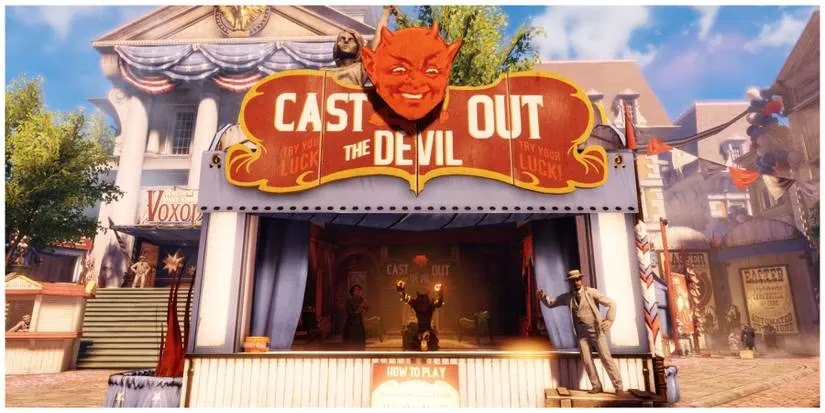
Some of the most effective tutorials are those the player doesn't even recognize as such. They function like a masterfully staged play where the stagehands are invisible, and the set itself teaches you how to interact with it. BioShock Infinite stands as a prime example. There is no formal "tutorial" menu or level. Instead, players are set loose in the breathtaking, floating city of Columbia during a vibrant fair. Here, the act of learning is synonymous with the act of exploration. Players discover what the plasmid-like "Vigors" do by interacting with carnival game stalls, and they learn about the world's lore by finding and playing audio logs called Voxophones. The tutorial is not a separate entity; it is the city itself, whispering its secrets to those who wander its streets. This approach feels as natural as learning the rules of a new city by walking its avenues, a stark contrast to tutorials that feel like being handed a bulky tourist guidebook at the airport.
Similarly, The Legend of Zelda: Breath of the Wild achieves tutorial perfection on the Great Plateau. This opening area is a self-contained microcosm of the entire Hyrule, a carefully curated sandbox of possibilities. The game provides a singular, distant goal—activate the four shrines—but offers no prescribed path. Players learn the physics of temperature, fire, and wind; they experiment with cooking and weapon durability; they discover that climbing is not just a mechanic but a philosophy. The tutorial is a promise, a statement of intent: this world obeys consistent rules, and your curiosity is your greatest tool. It treats the player not as a student needing instruction, but as a scientist presented with a fascinating new ecosystem to test.
The Subversive Lesson: Tutorials That Lie and Challenge
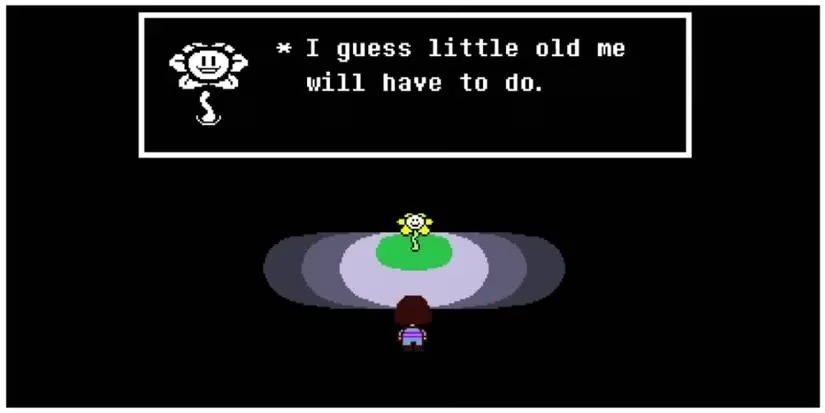
A more daring approach uses the tutorial to establish tone through deception or extreme challenge, setting expectations by deliberately subverting them. Undertale begins with a sequence that is a masterpiece of narrative misdirection. The player is greeted by Flowey, a smiling flower offering "friendship pellets." This cheerful introduction is a trap, a tutorial for the game's combat system that is also a lesson in betrayal. The pellets are deadly bullets, and the player's first encounter teaches them that nothing in this world is as it seems. This opening is a narrative landmine disguised as a welcome mat, instantly establishing the game's central themes of choice, consequence, and subverted RPG tropes.
Dark Souls takes a different kind of subversive approach. Its tutorial lulls players into a tentative sense of competence with manageable foes, like a gentle teacher offering simple practice problems. Then, it introduces the Asylum Demon. This first boss encounter is less a tutorial and more a rite of passage, a brutal but fair examination that immediately communicates the game's core tenet: victory is earned through observation, patience, and learning from failure. The tutorial isn't about teaching button inputs; it's about instilling a mindset. It's the gaming equivalent of a martial arts master who begins the first lesson by throwing the student to the ground, not out of cruelty, but to immediately teach respect for the discipline's difficulty.
The Narrative Vehicle: Tutorials as Story
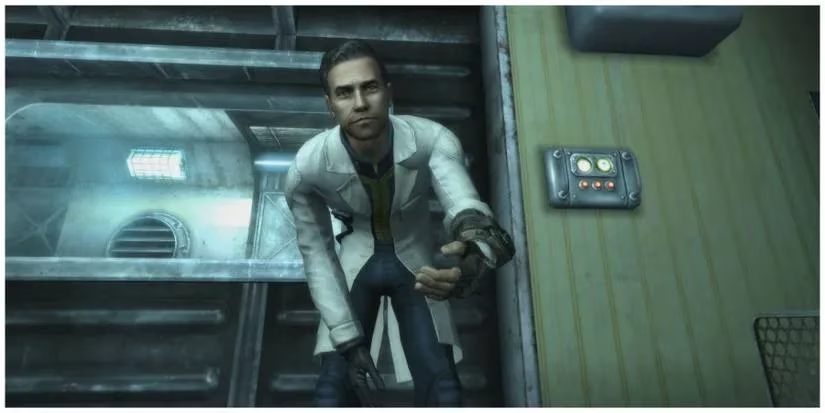
Perhaps the most emotionally resonant tutorials are those that are inseparable from the game's narrative, using the learning phase to build character and investment. Fallout 3 crafts an entire childhood for the player. The tutorial spans years, from the character's birth in Vault 101 through adolescence. Players choose their S.P.E.C.I.A.L. stats as a baby, take a school exam that influences their skills, and receive a BB gun as a birthday present, which serves as the first combat tutorial. This extended prologue builds a life, complete with a father figure, friends, and a sense of place. When that life is inevitably shattered, propelling the player into the vast Wasteland, the loss is palpable. The tutorial didn't just teach mechanics; it built an emotional foundation, making the player's journey personal. It functions like the first chapter of a novel, where the quiet establishment of character makes the ensuing chaos meaningful.
Portal 2 achieves a similar feat through tone and character. Awakening from stasis, the player is guided by the frantic, hilarious personality core, Wheatley. The dilapidated test chambers of the early game are a tutorial in environmental puzzle-solving, but the learning process is constantly undercut by Wheatley's inept commentary and the haunting, decaying beauty of the Aperture Science facility. The tutorial becomes a comedy routine and a piece of environmental storytelling simultaneously. Learning to place portals feels fun because the context—escaping a ruined lab with a foolish robot—is so richly engaging. It’s like being taught complex dance moves by a comedian in a beautiful, abandoned ballroom; the instruction is memorable because of the delightful absurdity of the setting.
The Action-Packed & Instinctual Onboarding
For games defined by chaos and fluidity, the best tutorials often mimic that energy, teaching through high-stakes immersion rather than slow explanation. Uncharted 2: Among Thieves famously begins in medias res, with protagonist Nathan Drake wounded and trapped on a train carriage dangling from a cliff. There is no safe space to learn controls. The tutorial is the life-or-death struggle to climb to safety. Every jump, every grab, every quick-time event is taught under immense pressure, perfectly setting the tone for the cinematic, pulse-pounding adventure to follow. It rejects the concept of a tutorial as a training ground, instead making it the first act of the blockbuster movie.
Just Cause 2 and Half-Life 2 take approaches that trust player instinct. Just Cause 2's opening mission, "Welcome to Panau," drops the player into a chaotic scenario with minimal explicit instruction, encouraging experimentation with the grappling hook, parachute, and vehicles through environmental design. It assumes the player's desire to cause mayhem is instruction enough. Half-Life 2's iconic "pick up that can" moment is a brilliant, invisible tutorial for its physics-based interaction and a subtle introduction to player agency. The Combine officer's command presents a simple binary choice, but the player discovers a third: rebellion. This tiny moment teaches that the environment is interactive and that the game world will react to the player's choices, a lesson more powerful than any text pop-up.
| Game | Tutorial Approach | Core Lesson Taught |
|---|---|---|
| BioShock Infinite | Exploration-Based World Building | Mechanics are discovered through environmental interaction. |
| Breath of the Wild | Curated Open-World Sandbox | Curiosity and experimentation are the primary tools for progress. |
| Undertale | Narrative Subversion & Deception | Appearances can be deceiving; player choice has weight. |
| Dark Souls | Trial by Fire (Boss Encounter) | Success requires observation, patience, and learning from failure. |
| Fallout 3 | Extended Narrative Prologue | Mechanics are tied to character growth and emotional investment. |
| Portal 2 | Character-Driven Comedy | Learning is engaging when wrapped in strong narrative and humor. |
| Uncharted 2 | High-Stakes In Medias Res Opening | The game's core loop (action-platforming) is the tutorial. |
Conclusion: The Evolution of the First Impression
As we move further into the 2020s, the most memorable game tutorials are those that understand their role as the first and most critical impression. They are no longer just functional necessities but foundational pieces of art direction, narrative, and game design philosophy. Whether they are seamless extensions of the game world, clever narrative deceptions, emotional backstory builders, or pure adrenaline rushes, these unusual tutorials share a common thread: respect for the player. They challenge the notion that players need to be handheld, instead offering them a door—sometimes a welcoming one, sometimes a deceptive one, sometimes a terrifying one—and trusting them enough to turn the handle themselves. In doing so, they transform the tutorial from a chore into a signature opening scene, setting the stage for everything that follows.
Leave a Comment