As I look back on more than a decade since Undertale first captured the gaming world's imagination, its enigmatic universe continues to fascinate me like a clockwork puzzle with pieces that never seem to fit perfectly. Toby Fox's 2015 masterpiece created a cultural phenomenon that transcends gaming, weaving a tapestry of mysteries that the community has been unraveling thread by thread. The game's refusal to provide definitive answers feels intentional—a canvas left partially blank for players to complete with their own interpretations and theories. This ongoing dialogue between creator and audience has sustained Undertale's relevance well into 2026, with new generations discovering its layered storytelling and older fans still debating its deepest secrets.
The Enigma of Frisk's True Nature
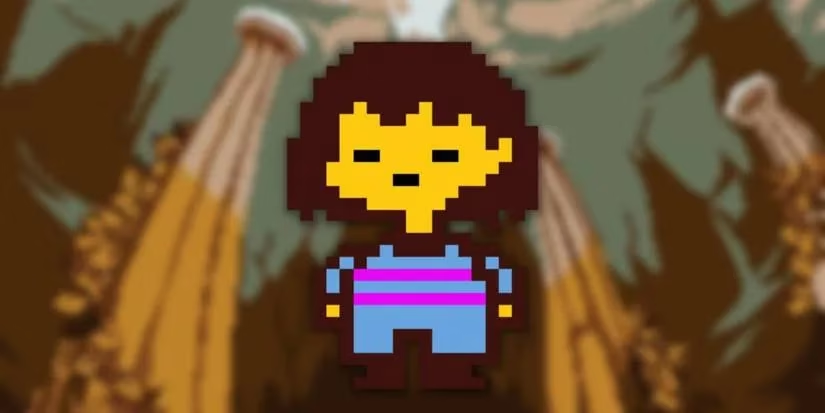
One of the most persistent theories that has evolved over the years concerns our protagonist, Frisk. The game presents them as a human child whose determination becomes the catalyst for either saving or destroying the Underground. Yet, something always felt... off about this premise. If monsters have been conditioned to fear and hate humans for centuries, why do so few characters immediately recognize Frisk as human? This observation, combined with Frisk's supernatural level of determination—a trait typically associated with humans but presented here in almost monstrous intensity—has led many to speculate that Frisk might not be human at all.
Consider these compelling points:
-
Lack of Immediate Recognition: Only a handful of monsters (like Flowey and Asgore) immediately identify Frisk as human
-
Unusual Determination: Frisk's ability to SAVE and LOAD reality operates like a metaphysical override system
-
Physical Ambiguity: Their sprite design shares characteristics with both human and monster designs
To me, Frisk moves through the Underground like a ghost wearing human skin—their presence accepted not because they belong, but because their true nature remains unseen. This theory suggests they might be a unique type of monster, perhaps one created during the human-monster war, or even a being from another reality entirely. Their journey becomes less about a human exploring monsterkind and more about a lost entity discovering what it means to have an identity at all.
Sans: The Skeleton in Human Clothing?
Moving in the completely opposite direction, we have the endlessly entertaining mystery of Sans. The grinning skeleton has become Undertale's mascot in many ways, but his nature remains hotly debated. Unlike his brother Papyrus, who proudly displays his skeletal form, Sans is always fully clothed. He never shows his bones, not even in his most vulnerable moments. This simple visual choice has spawned one of the most popular theories: Sans might actually be a human wearing a skeleton costume.
What makes this theory particularly compelling is how it explains Sans' otherwise inexplicable abilities:
| Ability | If Sans is Monster | If Sans is Human |
|---|---|---|
| Teleportation | Unprecedented for monsters | Could be advanced human technology |
| Knowledge of timelines | Unexplained | Suggests scientific experimentation |
| Gaster Blasters | Unique magic | Advanced weaponry disguised as magic |
Sans moves through time and space like a watchmaker who can rearrange the gears of reality itself—his understanding of the game's mechanics suggests he operates on a different level than other characters. The theory gains additional weight when considering his connection to W.D. Gaster and the CORE. If Sans was a human scientist involved with Gaster's experiments, his fall into the CORE might have transformed him, binding his consciousness to a skeletal form while retaining his human memories and capabilities.
The Fate of the Six Souls: Echoes in Empty Coffins
One of Undertale's darkest narrative threads concerns the six human children who fell before Frisk. Their souls were collected by Asgore, but what happened to their bodies? The game reveals their coffins lie open and empty in the castle basement. Flowey suggests Toriel might have given them proper burials, but this feels like an incomplete explanation—especially when Deltarune shows us that humans can survive temporary soul separation.
This has led to two major competing theories:
Theory 1: The Great Escape
This proposes that the six humans, like Kris in Deltarune, learned to function without their souls temporarily. They might have:
-
Regained consciousness after Asgore took their souls
-
Escaped their coffins in a weakened state
-
Found their way out of the Underground through alternative routes
-
Possibly survived on the surface, forever changed by their experience
Theory 2: Soul Reincarnation Theory
More poetically, some believe the human souls didn't just power the barrier—they found new vessels. This theory suggests each soul manifested as a monster embodying that soul's trait:
-
Blue Soul (Integrity) → Sans : His unwavering commitment to the timeline
-
Green Soul (Kindness) → Papyrus : His genuine desire to help everyone
-
Cyan Soul (Patience) → Napstablook : Their quiet, enduring presence
-
Orange Soul (Bravery) → Mettaton : His dramatic transformation and self-expression
-
Yellow Soul (Justice) → Mad Dummy : Their quest for proper recognition
-
Purple Soul (Perseverance) → W.D. Gaster : His continued existence across realities
To me, these lost children haunt the Underground like half-remembered melodies—their presence felt in every character's motivations and fears, even if their physical forms are gone.
The CORE: Beating Heart of the Underground
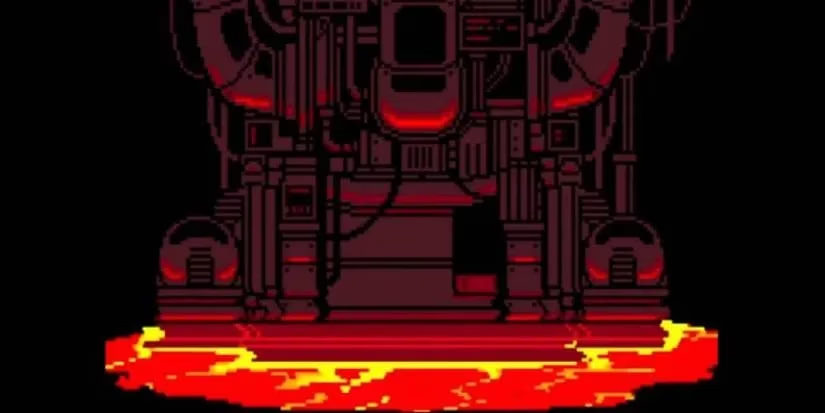
The CORE stands as one of Undertale's most fascinating locations—a technological marvel that feels alien in the otherwise organic Underground. Officially, it's a power generator converting geothermal energy into magical electricity. But its humming machinery feels like more than just infrastructure; it feels like a living thing, a mechanical heart pumping not just energy but possibility through the Underground's veins.
Several theories attempt to explain the CORE's true nature:
🔍 The Gaster Containment Theory: Since W.D. Gaster likely created the CORE and "fell into his creation," some believe his consciousness was distributed throughout the facility. The CORE doesn't just use energy—it IS Gaster, or at least what remains of him, his fragmented mind now powering the entire Underground.
🔍 The Determined Engine Theory: Given the CORE's connection to determination (Alphys used determination in her experiments nearby), some speculate it runs on concentrated DT. This could mean Chara's soul powers the facility, or that the CORE is slowly converting the entire Underground into a vessel for some greater consciousness.
🔍 The Reality Anchor Theory: The most recent speculation suggests the CORE stabilizes the Underground's reality. Sans' timeline awareness, the anomalies around Gaster, and even the save/load mechanics might all be side effects of the CORE's function as a dimensional anchor, holding multiple possible realities in delicate balance.
The CORE operates like a spider at the center of a web of causality—every thread of the Underground's reality seems to connect back to its humming chambers.
W.D. Gaster: The Font of All Mysteries
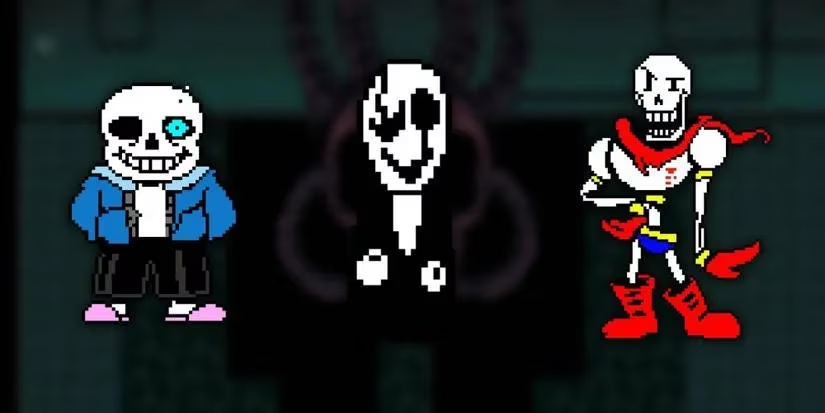
No discussion of Undertale theories is complete without addressing the game's most elusive figure. W.D. Gaster exists in the spaces between data—a character most players will never encounter directly, yet whose influence permeates everything. His connection to the skeleton brothers remains one of the most debated topics, with several compelling possibilities:
The Family Connection Theories:
-
Father Theory: Gaster created Sans and Papyrus as artificial beings or adopted them after their creation
-
Split Consciousness Theory: Gaster's fall into the CORE divided him into Sans (knowledge/memory) and Papyrus (emotion/optimism)
-
Creator Theory: Gaster designed the skeletons as assistants or prototypes, with their font-based names indicating his authorship
The Timeline Theories:
-
Fallen Scientist: Gaster discovered the true nature of the Underground's reality and was "erased" for it
-
Dimensional Traveler: Gaster exists across multiple timelines simultaneously, explaining his fragmented appearances
-
Narrative Architect: Some meta-theories suggest Gaster represents Toby Fox himself within the game's reality
Gaster feels like a photograph developing in reverse—the clearer we try to see him, the more he fades into abstraction. His Wingdings speech, his scattered followers, his association with void and darkness—all suggest a being who exists in the negative spaces of the game's reality.
Undertale and Deltarune: Connected Threads or Parallel Strings?
With Deltarune's ongoing development (we're now up to Chapter 5 as of 2026), the relationship between Toby Fox's two major works continues to inspire speculation. While Fox has stated they're separate universes, the connections feel too deliberate to be mere homage:
💭 The Fictional World Theory: Perhaps the most popular current theory suggests Undertale exists within Deltarune as fiction. The evidence:
-
Sans runs a shop in Deltarune's first chapter, seemingly aware of his Undertale popularity
-
Character personalities differ significantly between games
-
Undertale's mechanics (like saving) don't function the same way in Deltarune
💭 The Alternate Timeline Theory: Others believe these are branching realities created by different choices. The war between humans and monsters either happened (Undertale) or didn't (Deltarune), creating parallel worlds with similar people but different histories.
💭 The Dream Theory: A more poetic interpretation suggests Undertale represents Kris's dreams or imagination in Deltarune. The Underground's symbolic nature—confronting fears, making moral choices, finding family—aligns with a child processing complex emotions through fantasy.
To me, the connection between these worlds feels like two mirrors facing each other—infinite reflections that are similar but never identical, each showing a slightly different angle of the same fundamental truths about choice, consequence, and connection.
The Living Legacy of Theories
What strikes me most in 2026 isn't just the persistence of these theories, but how they've evolved. New discoveries in the game's code, community analysis of Toby Fox's other works, and even the way we discuss narrative in games have all refined these speculations into something approaching collaborative mythology. The theories are no longer just guesses about a game's plot—they've become a language through which we discuss deeper questions about identity, morality, and the nature of reality itself.
The beauty of Undertale's design is that it provides just enough evidence to support multiple contradictory theories simultaneously. Frisk can be both human and monster. Sans can be both a joke-cracking skeleton and a tragic human scientist. The CORE can be both a power plant and a prison for a fallen creator. These aren't plot holes—they're intentional spaces where players can build their own understanding.
As we await Deltarune's completion, I find myself returning to these theories not for answers, but for the questions they keep alive. In a gaming landscape increasingly dominated by definitive narratives and clear explanations, Undertale remains a rare space of productive uncertainty. Its mysteries aren't problems to be solved but conversations to be continued—a dialogue between game and player that, more than a decade later, shows no signs of ending.
Leave a Comment