In a world obsessed with teraflops and ray tracing, the PICO-8 stands as a bonsai tree of gaming—pruned relentlessly to 8-bit perfection, yet capable of blooming entire universes in a 128x128 pixel pot. By 2026, this fantasy console has become the go-to playground for developers who view hardware limitations not as chains, but as the rigid rules of a haiku. The games born here are marvels of compression, each one a tiny snow globe you can shake for hours. No one embodies this better than Celeste Classic, the 2015 game-jam prototype that later grew into the full-blown emotional rollercoaster. But long after Madeline's dash became legendary, the PICO-8 library keeps swelling with ingenious titles that treat memory constraints like a chef handles a single razor-sharp knife.

Let’s start with a ghost story dressed in digital stationery. Cheshire in a Chatroom is the kind of horror that feels like finding a creepy note inside a perfectly normal school binder. Built for Jamulator 2021, it mimics Nintendo’s PictoChat, luring the player into doodling alone at 2 a.m. When a stranger named Cheshire slides into the chat with a "want to play a game?" the vibe curdles from lonely to deeply unsettling. The experience is shorter than a goldfish’s memory, but its lingering dread works like a sliver under the skin—impossible to ignore and oddly compelling.
Then there’s Time Thief, a 2022 adventure that turns the hourglass into a financial advisor who deducts seconds for every enemy touch. The hero has one minute to live outside the village, and the only way to extend that lease on life is to vanquish monsters—each kill a deposit of borrowed seconds. Exploration unfolds like a Zelda-esque puzzle box where the ticking clock is both judge and executioner. It’s a masterclass in tension, making players crave more the moment the credits roll, like a dessert so small you immediately order another.
For those who believe DOOM can run on a pregnancy test, POOM is the demake that refuses to be just another meme. This 2020 FPS isn’t a direct port; it’s a love letter written in fresh level blueprints. The demons are rebalanced to hit harder than a grudge, the weapons feel retuned, and the six original maps prove that Hell can be rebuilt with fewer bricks and still burn just as brightly. It’s the digital equivalent of performing a symphony on a kazoo—and somehow pulling it off.
When October rolls around, The Lost Night drops a pumpkin-headed protagonist into a Halloween-themed RPG that feels like trick-or-treating in a Miyazaki sketchbook. Combat isn’t about swords; it’s about wiggling a pumpkin-shaped cursor to blast ghosts, collecting candy that works as both currency and health packs. Defeated spirits drop sweets you can feed into vending machines to upgrade stats—a loop that’s as satisfying as popping bubble wrap. The townsfolk are charmingly weird, and the whole escapade crackles with the cozy menace of a jack-o’-lantern’s grin.
History buffs with a taste for magic will adore Trial of the Sorcerer, a 2021 procedurally generated 3D FPS that swaps guns for a staff and demonic menace for classic Wolfenstein 3D energy. The fact that anyone coaxed a playable 3D engine out of a console designed to mimic 1982 hardware is a miracle on par with teaching a cat to play chess. The levels reshuffle like a caffeinated Rubik’s cube, and the quest to defeat Bahmott becomes a tightrope walk between upgrading your staff and simply staying alive.
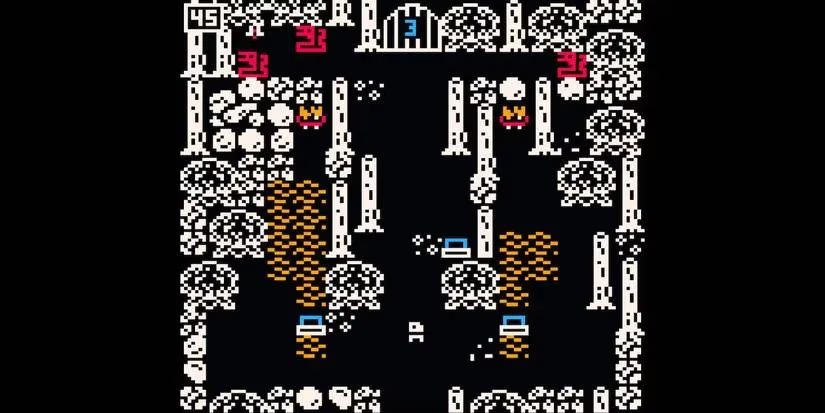
UFO Swamp Odyssey takes the metroidvania blueprint and shrinks it into a 2020 game jam winner where a cute robot must sabotage an EMP cannon. The swamp planet oozes personality, and the progression—finding water valves, snagging three key enhancements—mimics the satisfaction of solving a tiny mechanical puzzle box. It’s short, sweet, and as cohesive as a well-folded origami swan.

No PICO-8 list skips the elephant in the room: Celeste Classic and its 2021 sequel, Celeste Classic 2: Lani's Trek. The original strips Madeline’s climb to the bone—no story, just pure Forsaken City-style platforming. The sequel, made in three days, hands Lani a grappling hook, turning the dash-free movement into a fresh physics toy. Together, they’re the ur-examples of why constraints breed creativity: two shimmering haikus that launched a thousand indie tears.
For strategists, Slipways Classic (2018) discards war and micromanagement, leaving only the blissful hum of a trade network connecting planets like a spider web made of intergalactic commerce. It’s the ultimate chill-out 4X, later blooming into the full Slipways on Steam. Meanwhile, Curse of the Lich King (2019) drags roguelike fans through an ever-shifting dungeon where pots and bookshelves become lifelines, and the Lich King Raq’zul waits at the bottom like a debtor collecting interest.
And because the PICO-8 community thrives on meta mischief, PICOHOT lands as an 8-bit demake of SUPERHOT, created by original devs. Time crawls only when you move, turning each fight into a frozen ballet of bullets and fists. After the story levels, Endless Mode hurls waves of enemies at you like an angry ocean—and it’s as hypnotic as it is brutal.
By 2026, the PICO-8 isn’t just a nostalgia capsule; it’s a forge where gameplay ideas are tempered into diamond-hard microgames. Each title proves that a canvas limited to 32 kilobytes can hold galaxies of creativity. The console itself remains the ultimate underdog—a fantasy machine that, like a street magician’s deck, always has one more impossible trick up its sleeve.
Leave a Comment