In the intricate digital landscapes of 2026, the act of taking a virtual life remains a fundamental mechanic, yet a growing number of game designers are weaving sophisticated systems to actively discourage wanton violence. From stealth operatives to theme park moguls, players are finding that a trigger-happy approach often comes with severe, often unexpected, consequences. These systems, functioning like an invisible moral compass or a meticulous corporate auditor, transform simple gameplay into a nuanced reflection of choice and consequence. While eliminating lines of code lacks the weight of real-world morality, modern games are increasingly ensuring that virtual bloodshed is not a cost-free endeavor, embedding penalties that range from narrative bleakness to outright failure states.
The Stealthy Stigma: Dishonored's Chaotic Reckoning
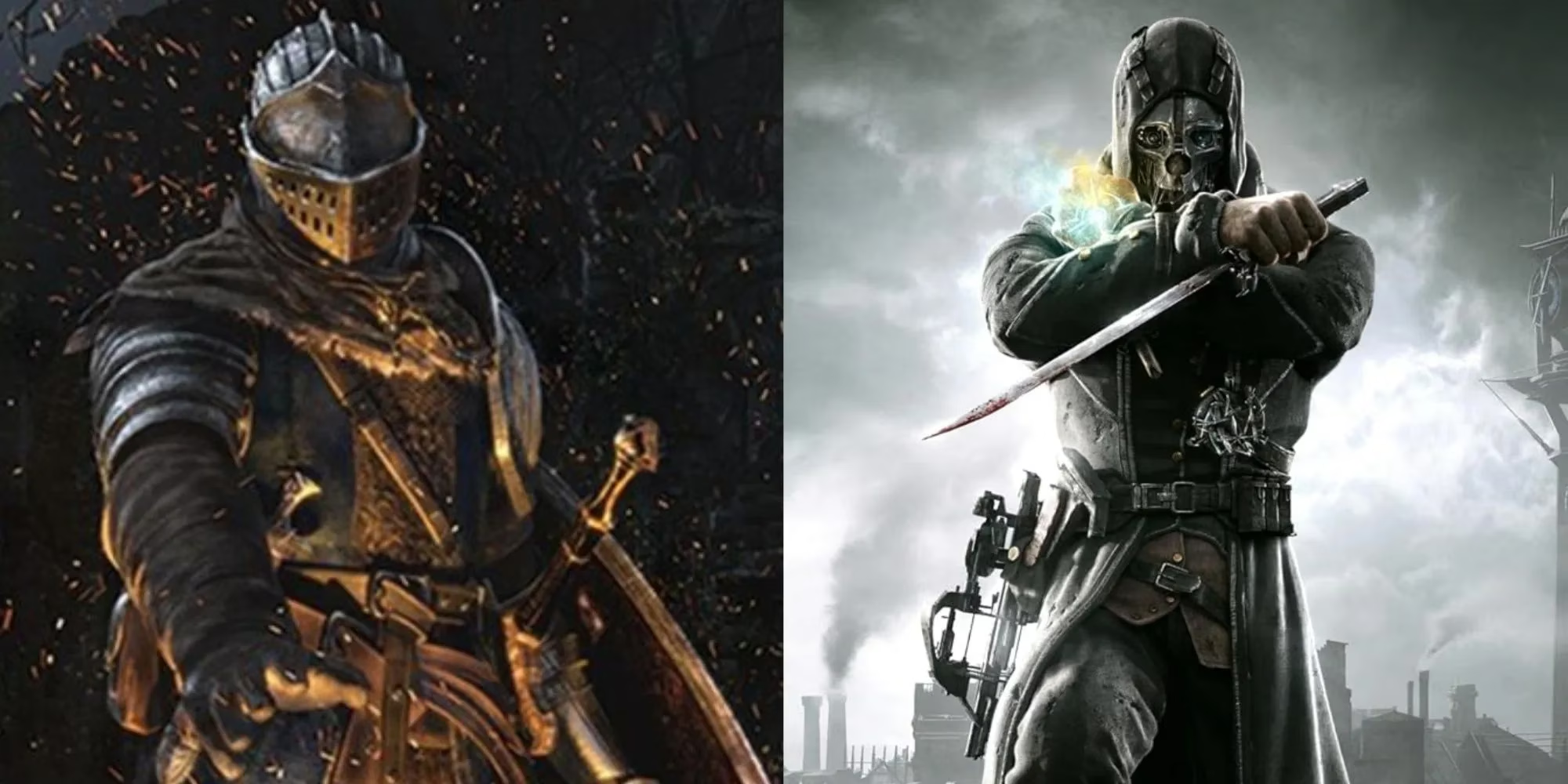
In the realm of stealth, killing has become as frowned upon as a bull in a china shop, a clumsy act that shatters the delicate silence of infiltration. Dishonored stands as a prime example, casting players as Corvo Attano, a framed bodyguard navigating a plague-ridden city. The game famously employs a "Chaos" system that reacts dynamically to the player's lethality. Excessive killing darkens the game's world like a spreading inkblot, leading to:
-
Increased Difficulty: More hostile guards, aggressive rats, and pervasive weepers infest the streets.
-
Narrative Consequences: The story culminates in a darker, bleaker ending, reflecting the city's descent into despair.
-
Social Deterioration: NPC interactions become more cynical and hostile, isolating Corvo further.
The game doesn't forbid violence but frames it as a corrupting influence, a choice that stains both the world and the soul of the protagonist. The initial false accusation of murder hangs over the player, making a pacifist or low-lethality run feel like a personal vindication against the state's narrative.
Creative Constraint: Scribblenauts Unmasked's Pointed Penalty
The Scribblenauts series is built on the god-like power of a magical notebook, allowing player Maxwell to conjure almost anything into existence. Scribblenauts Unmasked, set in the DC Universe, amplifies this by granting access to iconic heroes and villains. One might assume such power renders conflict trivial—simply attach the adjective "dead" to any foe. However, the game cleverly disincentivizes this brute-force solution:
-
Point Reduction: Using lethal adjectives like "dead" or "exploded" significantly reduces the Starites (points) earned in a level.
-
Mission Failure: In story-focused missions, causing an unnecessary death can trigger an immediate "Game Over," forcing a more thoughtful approach.
This mechanic is less about Batman's no-kill rule and more about preserving the game's core creative challenge. It forces players to think like a puzzle-solver rather than a terminator, using the environment and non-lethal adjectives (e.g., "friendly," "sleeping," "tethered") to overcome obstacles. The game argues that true power lies in ingenuity, not annihilation.
Corporate Carnage: RollerCoaster Tycoon's Bottom Line
Where other games employ moral frameworks, RollerCoaster Tycoon presents killing through the cold, hard lens of business management and public relations. Deliberately designing a death-trap rollercoaster or drowning guests in a pond is possible, but it's terrible for business. The consequences are purely pragmatic:
| Action | Consequence |
|---|---|
| 🎢 Faulty Ride Design | Guest death, lawsuit news item, park rating plummets. |
| 🚫 Neglected Facilities | Guest deaths from starvation/dehydration, negative word-of-mouth. |
| 🕳️ Trapping Guests | Gradual death, widespread panic among other guests. |
These events cause the park's value and popularity to nosedive, making it nearly impossible to achieve scenario objectives like attracting a certain number of guests or reaching a specific park value. Ironically, this very prohibition has made simulated guest demise a perverse pastime for content creators, proving that even the strictest corporate penalties can't curb some players' destructive impulses. The game treats guest life not as sacred, but as a key asset—a resource as vital as electricity or cash flow.
The RPG Dilemma: Dark Souls' Permanent Consequences
In the punishing world of Dark Souls, death is a constant companion for the player. However, the game teaches a harsh lesson in restraint regarding Non-Player Characters (NPCs). While most NPCs can be attacked and killed, their deaths are permanent for that playthrough. This creates a high-stakes economy of interaction:
-
Lost Services: Killing a blacksmith like Andre of Astora locks you out of weapon reinforcement and modification for the rest of the game.
-
Missed Quests: Murdering potential allies severs entire storylines and unique rewards.
-
Tempting Drops: NPCs do drop their unique gear and items upon death, presenting a cruel temptation.
The recommended strategy for the truly mercenary is to use an NPC's services fully—like a farmer milking a cow dry—and then eliminate them near the game's end to claim their loot. This cold calculus turns morality into a resource management puzzle, where friendship is a currency spent for later gain.
The Ultimate Deconstruction: Undertale's Unforgiving Memory
Undertale stands as the definitive exploration of this theme, deconstructing player agency with surgical precision. Its "Genocide Route" is not just punished within a single playthrough; it permanently scars the game's universe. After systematically exterminating every monster, the player is confronted by the demonic first human, Chara. The world is erased, and restoring it requires selling the protagonist's SOUL. This action leaves a permanent, malevolent save file, a ghost in the machine that haunts future playthroughs:
-
Altered Endings: Even achieving the perfect "True Pacifist" ending afterward will be forever tainted. Chara will appear in the final scene, a grinning reminder of the previous genocide.
-
Meta-Consequences: The game remembers your sins across resets and timelines, arguing that some choices are foundational and irreversible.
Undertale' punishment is existential. It suggests that the player's desire for completionist violence is a corruption that transcends the game's narrative boundaries, making the Genocide Route a hollow, self-defeating victory that poisons all future joy. It is a cautionary tale where the game itself becomes a judge, jury, and jailer of the player's conscience.
In 2026, the trend of punishing in-game killing continues to evolve, moving beyond simple morality meters. These games embed consequences into their core systems—be it chaos, creativity, capitalism, or cosmic memory—teaching players that in a well-designed world, every action, even against mere code, ripples outward with meaningful effect. The virtual kill is no longer free; it's a transaction with a steep, often creative, price. 🎮⚖️
Leave a Comment