It began as a whisper in the dust of an ancient forum, a question posed to the void of Reddit: what if the underground world of monsters and moral quandaries could be reborn not in flat pixels, but in the cubic embrace of Minecraft? The year was 2022, and a builder known only as Pitiful-Meatball laid the first stone of what would become a colossal act of digital devotion. By 2026, that whisper has roared into a fully playable, first-person Undertale experience built entirely within Mojang’s sandbox. The project did not simply replicate the 2015 RPG; it translated its soul into a new tongue, like a scribe pressing ancient hymns into a language of cubes and redstone.
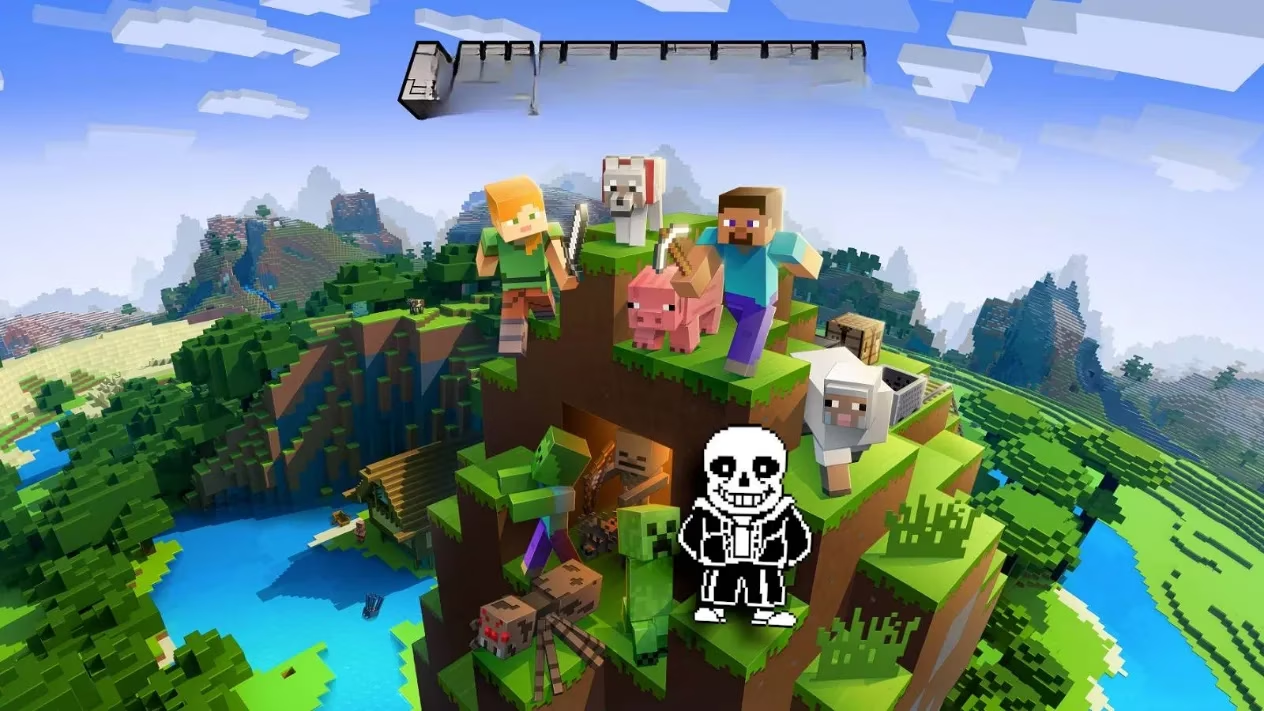
Pitiful-Meatball didn't want to just build static monuments. He became a cartographer of nostalgia, tracing every tile of the Ruins, every glinting save star, and every echo flower’s whispered secret onto the infinite flatland of a Minecraft world. The original Undertale, Toby Fox’s subversive masterpiece that taught a generation that graphics don’t make a game, found a strange mirror in Minecraft—another title whose simple geometry never stopped millions from painting entire universes. Where Fox used minimalism to subvert RPG tropes, Pitiful-Meatball used Minecraft’s blockiness to amplify childlike wonder, turning the grim corridors of Hotland into a Lego cathedral of glowing magma blocks and glass panes.
🎮 The Vision: From 2D Quirks to 3D Cubes
Pitiful-Meatball’s goal was audacious from the start: “I want to reconstruct the entire game,” he wrote in a Reddit thread that quickly became a beacon for the community. At the time of that first showcase, a 17-day-old video revealed a staggering amount of progress—Undertale’s hallways stretching into a first-person vista, their familiar rhythm now tangible in three dimensions. It was not a mechanical port, but a poetic reinterpretation. Each room grew like a coral reef: slowly, methodically, block by colored block. The effort mirrored how a translator must balance fidelity and fluency; Pitiful-Meatball had to decide, for instance, whether a save point should be a beacon of light or a simple button, a decision that could ripple through a player’s entire emotional journey.
The recreation became a lesson in digital archaeology. With no official tools to convert Undertale’s data into Minecraft commands, Pitiful-Meatball rebuilt the combat system by weaving redstone dust into a tapestry of logic gates and command blocks. The iconic bullet-hell dodging sequences evolved into a dance of armor stands, slime blocks, and teleport commands, preserving the frantic heartbeat of a fight against Papyrus or Sans. It was as if he were stitching together a quilt using threads from two different centuries, the needle dipping into nostalgia and emerging with innovation.
🏗️ A Community Built on Infinite Creativity
Pitiful-Meatball’s project did not exist in isolation. It was part of Minecraft’s ongoing legacy as a digital primordial soup, where players conjure anything from interstellar musings to architectural replicas. One creator had already modeled the sun, Earth, and a black hole to scale; another labored to transform Hyrule into a blocky epic. These projects are like a vast mycelial network beneath the soil of gaming culture, each creation feeding the next through inspiration and shared knowledge. The Undertale project, in particular, stood out because it did not just replicate scenery—it reanimated a narrative. It answered the question: can you make someone cry using only cubes and a resource pack? By 2026, the answer was a resounding yes, as beta testers streamed their live reactions, choking up when the pixelated hearts of monsters broke along familiar beats.
The build demanded over three years of obsessive crafting. Waterfall’s quiet luminescence had to be conjured with sea lanterns and carefully placed blue glass, the ambient glow mimicking the original’s somber mythos. The CORE became a functional labyrinth of redstone elevators and piston doors, a mechanical beast that would have daunted even the most experienced engineers. Pitiful-Meatball often spoke of moments where the process felt arcane, as if he were an alchemist trying to distill the essence of one art form into another. The Sans fight, the project’s crowning jewel, used a system of randomized command triggers to replicate the deceptive simplicity of the original—each bone toss a precisely calculated earthquake in the Minecraft engine.
⚙️ The Alchemy of Translation
This reconstruction did more than satisfy nostalgia hunger; it demonstrated a core truth about Minecraft’s staying power. By 2026, Mojang’s sandbox had been on the market for over fifteen years, outliving console generations and countless AAA trends. It persists because it is not a game but a dialect of human creativity. Pitiful-Meatball’s Undertale is a testament to that language, a shining example of how a community can elevate a “children’s game” into a vessel for meditations on mercy, consequence, and friendship. The project’s full release on community servers allowed a new generation—kids who were toddlers when Undertale first launched—to experience Flowey’s mockery and Toriel’s warmth in a bewildering new dimension.
What began in a subreddit thread has now been enshrined in the Library of Congress of Minecraft builds. Pitiful-Meatball occasionally posts updates about his next obsession—a rumor he’s translating EarthBound, Fox’s main inspiration—but the Undertale map remains his indelible mark. Players walking through his blocky Ruins often stop at the first save point and recall that age-old message: “Knowing the mouse might one day leave its hole and obtain the cheese… It fills you with DETERMINATION.” And in that moment, staring at a glowing command block dressed as a dusty star, they understand that the cheese was always the journey itself, built one impossible block at a time.
Minecraft is available now for Mobile, PC, PS5, Switch, Xbox Series X/S, and as a cross-platform bedrock for imagination.
Leave a Comment